Jobsite Awards · buyer guide
How should a perpetual construction milestone plaque be built?
Choose a perpetual plaque when one defined recognition program will add entries over time and someone will manage its plate updates. Choose a single inscription when the object records one finished milestone. Jobsite Awards worldwide enquiries should specify the board, header, plate arrangement and future replacement method before choosing a wood or metal finish.
Reviewed 2026-09-05 · AI-assisted editorial review. General buying guidance; illustrative scenarios are not customer case studies. Images are AI-generated concepts.
A perpetual board is a physical record with limited spaces. Its useful life depends partly on how entries are defined and how new plates fit the original construction. The buying decision is therefore more specific than choosing a large plaque with spare room. Establish what each small plate represents before deciding how many spaces the board needs.
For a construction business, that might be one approved project recognition per entry or one defined period in an internal program. This guide does not validate a safety statistic or define how a company should measure one. The responsible organization must supply and approve any factual milestone before it becomes permanent text.
What is included in a complete perpetual plaque?
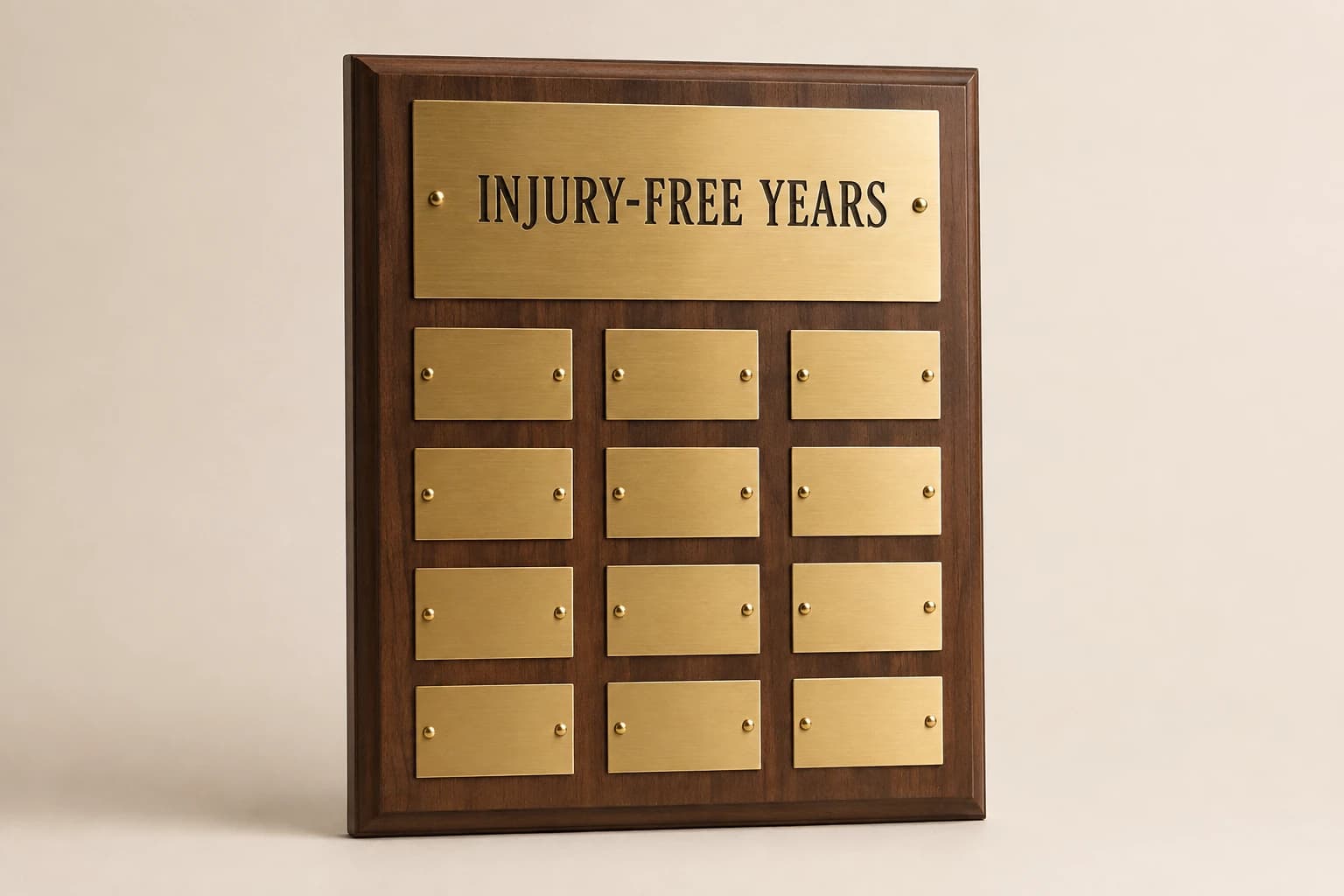
A complete perpetual plaque should identify the board, main header, individual plate positions, initially engraved plates and blank plates. Ask which parts arrive fitted and which can be removed or ordered later. A photograph with every position filled does not establish the initial engraving or replacement scope included in a quotation.
Apple Awards describes one product with an engraved header, one personalized plate and forty-four blank plates. That is a concrete example of how board capacity and initial personalization can differ. It is not a capacity, material or inclusion specification for a Jobsite Awards product; the buyer should obtain those details for the selected board.
Ask for the assembled layout rather than a list of plate dimensions alone. Borders, the main heading and spacing between entries affect how the finished record reads. If the maker proposes blank plates in every unused position, confirm whether later personalization uses those supplied blanks or requires newly manufactured plates.
Sources: Apple Awards: Cherry Finish Perpetual Plaque with 45 Plates
How should you choose the number of plate positions?
Choose plate capacity from the program’s defined entry unit and intended display period, leaving any future space as an explicit planning choice. One plate per project creates a different board from one plate per year. Do not select capacity from a generic annual-award photograph before deciding what each entry will mean.
Write the entry rule in the purchase brief. For example, an internal project-recognition board might allow one plate for each completed project chosen by the company. The plate should carry enough identifying information to distinguish those projects without turning the board into a detailed job register. Keep the supporting records elsewhere.
Consider what happens when the board fills. The next step might be a companion board, a new dated series or a larger initial layout. Ask the designer to show how the heading communicates the intended period. Empty spaces are useful only if they correspond to an understandable future record, not if they imply achievements that have not occurred.
What makes future engraved plates compatible?
Future plates need a retained specification for size, material, finish, attachment and text layout. Ask the maker which existing components can be reused and what information a later order requires. Matching the approximate color is not enough; a replacement must fit the board’s actual plate arrangement and approved inscription area.
Keep a plate drawing and the approved artwork reference with the board record. Include the relationship between any holes and the plate edges if the proposed construction uses holes. If attachment is concealed or adhesive, request the maker’s specific replacement instructions rather than improvising removal from a generic plaque tutorial.
Ask whether future plate supply is a current option, and record the contact and product reference. Do not turn that discussion into a promise of indefinite availability. A useful specification allows another proposal to be assessed if the original component changes, while the existing board provides the physical reference for any replacement sample.
How should entries stay readable as the board fills?
Use one approved entry layout with a stable hierarchy for project name, recognition description and date or period. Test the longest realistic entry before committing the plate size. A board that looks balanced with one short sample can become crowded when several later entries carry longer project titles or different wording.
Ask the company to choose which information belongs on the small plate and which belongs in its records. An internal project code may help distinguish similar names, but it should not displace the text viewers need to understand the recognition. Keep unverified claims or provisional results out of the sample presented as final wording.
Review the board with several different fictional entry lengths placed together. This reveals whether later plates will demand new font sizes or inconsistent line arrangements. If the format cannot handle the intended entries, revise the plate area or simplify the entry rule before choosing the final board dimensions.
Illustrative example: how much capacity would an eight-position board provide?
In this illustrative internal recognition program, one plate represents one approved project entry. The company selects an eight-position board and starts with three entries, leaving five blank positions. The example demonstrates capacity planning only; its fictional project names do not claim completed work or verified safety results for any company.
The sample entries are North Workshop, River Store and East Depot, each paired with the neutral heading Project Recognition. Eight positions minus three occupied positions leaves five future entry spaces. Those blank spaces are capacity, not additional awards owed to recipients and not evidence of five future projects. No generic quantity calculator is needed to make that distinction.
The worksheet includes a longer test entry, West Service and Storage Building, as an artwork stress test rather than a fourth approved entry. The buyer asks the maker to show it on the same plate size before approval. That test can change the layout decision while leaving the fictional initial board capacity and three-entry scope unchanged.
Use the article’s example files
All project names and capacities are illustrative. The long-name row tests layout and is not an occupied position; use the blank project row for your own approved entry rule and plate specification.
Who should update and maintain the perpetual board?
Assign one person to hold the board specification, collect approved entry text and request later plates. That owner should follow the maker’s instructions for replacing components and caring for the selected finish. A perpetual plaque needs a reliable update record so its physical entries remain connected to the organization’s approved information.
Keep a simple position map that records which inscription belongs in each slot. If the board is read in rows, state the intended order before the first plates are fitted. Do not fill empty positions with placeholder achievements merely to make the presentation look complete. A blank plate can remain visibly blank until its entry is approved.
When a wording correction is needed, identify the affected plate and preserve the correct source text. Ask whether replacement can occur without disturbing neighboring pieces under the proposed construction. This is more useful than assuming every perpetual plaque uses the same screws, adhesive or removal method.
What should a perpetual-plaque quote distinguish?
Ask for separate identification of the complete board, header personalization, initial engraved entries, supplied blank plates and later replacement options. Include the proposed capacity and attachment method. The quoted unit should be clear about whether it is a complete plaque, a plate-only order or a service applied to supplied blank components.
Send Jobsite Awards the approved entry rule, fictional longest-name test if final entries are pending, destination and intended display arrangement. For worldwide enquiries, request the actual production and delivery proposal after initial personalization and sample review are understood. Do not use another seller’s stock-board timing as a promise for a custom arrangement.
Approve the board layout and plate specification together, then keep both for future orders. The useful purchase is a coherent updateable record: viewers can understand each entry, the next plate has a defined place and the company knows which information must be approved before the physical record changes.
Should you buy a single plaque, perpetual board or companion series?
Choose a single plaque for one complete recognition statement, a perpetual board for a defined sequence of entries, or companion plaques when each milestone needs its own larger composition. Compare how the record grows and what must be replaced. The best choice follows the recognition program’s information structure, not simply available wall space.
| Option | Single inscription | Perpetual board | Companion plaque series |
|---|---|---|---|
| Entry structure | One statement can use the full face without reserving future positions. | Each entry follows the same plate format within a limited board capacity. | Each plaque can carry a distinct project composition while sharing a design family. |
| Later additions | A new milestone usually needs another object or a specifically proposed replacement face. | Request the next compatible plate and record its assigned position. | Add a complete plaque; plan the relationship to the existing display. |
| Initial quote | Complete plaque with approved inscription and mounting arrangement. | Board, header, engraved plates and blanks identified individually within the scope. | Complete plaques with a defined common design and any project-specific artwork. |
| Record to retain | Approved final statement and product reference. | Plate drawing, attachment instructions, entry template and position map. | Series design reference and layout plan for the wider display. |
What should buyers ask about perpetual construction plaques?
A perpetual construction plaque works when the entry rule, plate capacity and replacement method are clear. Before buying, confirm exactly what the initial order includes and how the company will request the next entry. Keep any factual milestone approval separate from the product specification so the board records only authorized statements.
What affects a perpetual plaque’s cost and schedule?
The board size, header, plate material, total positions and number of initially engraved entries define the quote. Custom layout, supplied blanks, sample review and destination can change the proposal. Ask Jobsite Awards for current project pricing and timing, including whether a later plate order is priced or scheduled separately from the original board.
Do blank plates mean future engraving is included?
No. Blank plates and later personalization are separate scope questions. Ask whether the initial quote includes engraving those blanks later, supplying new personalized plates or neither. Retain the written answer with the board record so a future program owner does not treat physical blank capacity as a prepaid service.
Can the first board have more spaces than approved entries?
Yes as a deliberate capacity choice. State how many entries are currently approved and how many positions remain blank. Do not label the blank positions with unverified milestones. The heading and entry rule should make the future use understandable without implying that the empty spaces already represent completed projects or achievements.
Can a new plate be made from a photograph of the board?
A photograph helps identify appearance, but a compatible replacement needs the actual plate dimensions, material, finish, attachment and artwork area. Supply the retained specification or request a sample-based review. An approximate visual match alone does not establish that the replacement will fit the board or align with neighboring entries.
Can a recognition board verify a safety milestone?
The plaque is a display of approved text, not a verification method. The organization must define and substantiate any safety statement through its responsible reviewers and records. Give the maker only the approved wording for production, and do not treat a catalog product name or illustrative inscription as evidence that a milestone occurred.
Sources and scope
The sources below support the cited technical details. The ordering workflows are editorial recommendations. Your project specification, price and schedule are established in the written quote and approved proof.
- Apple Awards: Cherry Finish Perpetual Plaque with 45 Plates · checked 2026-09-05
Which buying guide should you read next?
All buying guidesName the actual project milestone before writing a dedication, so a groundbreaking tribute does not imply that construction is complete.
Pack personal recognition pieces for their presentation and technical labels for their controlled destination, even when both share one outer shipment.