Jobsite Awards · buyer guide
Unique label layouts versus repeated copies
For Jobsite Awards worldwide orders, a unique layout is an approved combination of content and design that requires its own artwork record. Ten copies of the same legend in the same physical format can share one layout. Ten different equipment identifiers usually require separate content records even when the typography is identical.
Reviewed 2026-09-05 · AI-assisted editorial review. General buying guidance; illustrative scenarios are not customer case studies. Images are AI-generated concepts.
State the rule used in the project so reviewers count consistently.
Dimensions, orientation, language or a different technical symbol can also create a distinct layout. Do not decide uniqueness from the headline alone. A label with the same words but a different required size may need a separate production reference. The responsible technical and design reviewers should agree which fields define an approved variant.
How do you keep artwork count and piece count in separate columns?
For every approved layout, record the number of physical copies requested. A summary should show both the total distinct layouts and the total pieces. This prevents a quote for three designs from being mistaken for three labels when each design needs several copies.
If the maker prices setup or variable-data work separately, ask how the proposal interprets those counts. Do not assume all suppliers use the same definition of a unique layout. A clear schedule lets them describe their scope against the same underlying records and makes the resulting proposals easier to compare without guessing which work is included.
How do you distinguish repeated legends from sequential identifiers?
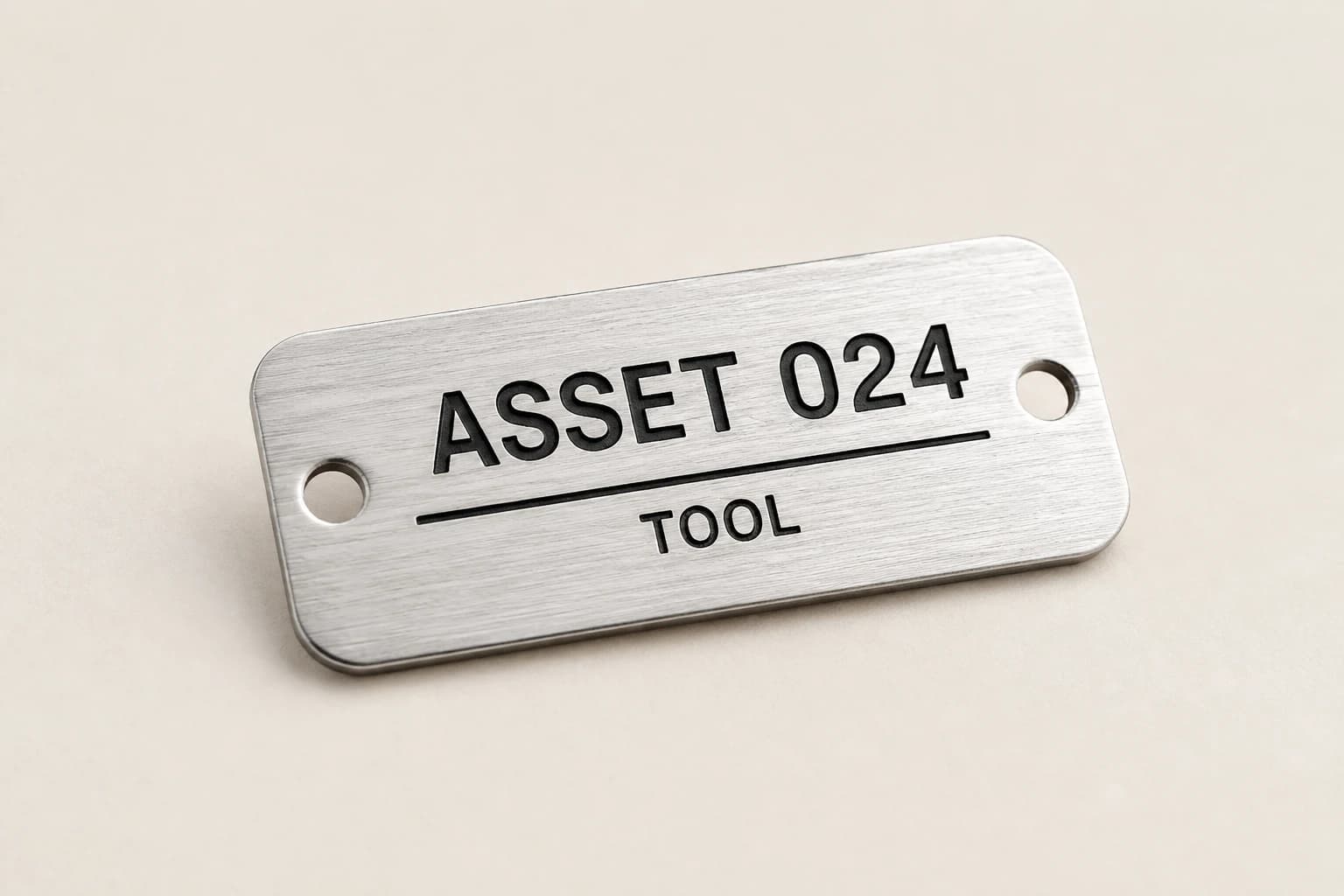
A repeated legend means the approved text is intentionally identical on several pieces. A sequence of equipment numbers is different: each number is a distinct identifier even if a common template generates the artwork. Keep the full approved list rather than asking production to invent the sequence from a starting number and an ambiguous count.
If the project does authorize a generated sequence, have the responsible technical owner approve the exact resulting list before release. Check leading zeros, prefixes, skipped values and any suffixes. The arithmetic can tell you how many entries exist, but it cannot establish whether a missing number is an error or a deliberate part of the project's naming system.
Illustrative example: How do three layouts produce seventeen physical labels?
Imagine a fictional schedule with four copies of layout A, six copies of layout B and seven copies of layout C. There are three unique layouts and seventeen physical labels because four plus six plus seven equals seventeen. The bulk-tag calculator uses one group per layout with the copy quantity in the pieces-per-group field.
The loaded rows are Layout A | 1 | 4, Layout B | 1 | 6 and Layout C | 1 | 7, with no spares. The result shows seventeen total pieces. The worksheet also records three layout references so a reviewer can see why the artwork workload differs from the production count.
If two copies of layout B need a different legend, create a new approved layout for those two pieces and reduce the original B copy count from six to four. The physical total remains seventeen, but the unique-layout count becomes four. Both summaries must change appropriately; adding the new layout without reducing B would over-order two labels.

How do you map copies to destinations without duplicating masters?
List where each group of copies will be used, using the approved equipment or location references. If one master layout goes to several areas, split the distribution rows while keeping the same artwork reference. The sum of those rows should equal the approved copy count for that layout.
Avoid copying the entire artwork file into a separate folder for every destination and then editing each independently. That can create unintentional variations that are hard to detect. A controlled master with explicit destination allocations makes a later correction easier to scope and helps receiving staff distinguish a missing copy from an incorrect design.
Count copies across three distinct layouts
Load the fictional worked example, then replace every assumption with your approved project inputs.
Method: Multiply groups by copies in each entered row. Layout uniqueness and technical meaning are determined by the approved schedule.
Build your plan
Use one row per tag type. For example: Valve labels | 20 | 2. Material, dimensions, legend text and mounting belong in the final tag schedule.
Use the article’s example files
Fictional example rows show how to separate physical quantities, wording and approval references. Replace them with your project schedule. HOLD and SAMPLE entries are not production instructions.
How do you review unique content before repeated production?
Ask the responsible technical reviewer to approve every unique legend and relevant specification. A design reviewer can check the common visual system, but approval of one sample does not establish the correctness of all equipment identifiers. Use a proof set that clearly identifies each layout and its selected revision.
For repeated copies, confirm that the maker understands which items must remain identical. If variable fields are expected, list them explicitly. A production process that automatically increments a number can be wrong for a repeated legend, while a repeated-copy process can be wrong for a sequence. The schedule should remove that ambiguity before manufacturing.
How do you treat spare copies as an explicit decision?
If the project wants spares, state which layouts need them and how many. A generic spare total may be insufficient when several legends are not interchangeable. The maker should not choose which technical identifier receives the extra pieces. Specify each spare legend explicitly.
Keep spare destinations or storage references separate from installed allocations. A label held in inventory should not be counted as already placed on equipment. If blanks are proposed instead of personalized spares, ask whether and how they can later receive the approved content under the actual production process. A blank panel is not automatically a usable replacement identifier.
How do you receive by layout and count by copies?
At receipt, first confirm that every approved layout is represented and matches its selected proof. Then count the physical copies of each layout. Seventeen labels can still be wrong if one layout is duplicated and another is missing. The receiving worksheet should show expected and received quantities per master reference.
For sequential identifiers, reconcile the actual list rather than relying on a total. A duplicate number and a missing number can cancel numerically. Any technical acceptance beyond text and quantity should follow the project's approved process. Keep discrepancies specific so the responsible owner can authorize a precise correction.
How do you use the distinction to improve the next quote?
Retain a compact record of unique layouts, copies per layout and accepted specifications. When a new order arrives, identify whether it repeats an existing approved layout, changes its content or introduces a new format. That lets the maker scope the actual work without treating every request as a completely new project.
Do not assume a previous setup charge or lead time applies unchanged. Ask for a current proposal against the retained reference and new quantities. The historical schedule improves clarity, but it is not a current price or capacity promise. The practical benefit is a smaller, more accurate specification conversation rather than an invented expectation of automatic savings.
How do you explain the counting unit on every summary?
Place the words unique layouts and physical copies beside their totals in the quote request. Avoid a single column called quantity when the surrounding document switches between artwork and manufactured objects. A reader should be able to understand the unit without reconstructing the calculation.
When a complete assembly contains several labels, add an assembly reference instead of redefining the label total. The same project can legitimately have three layouts, seventeen labels and a different number of receiving kits. These are separate summaries of one approved schedule. Keeping their labels explicit prevents a correct number from becoming an incorrect purchasing instruction when it is copied into another form.
How do you keep repeated copies tied to one approved master?
A repeated legend should point to one selected artwork revision unless the project explicitly requires a variation. Do not maintain several nearly identical master files simply because copies go to different locations. Instead, connect the approved artwork reference to each destination row.
When the legend changes, identify every physical copy that depends on that master and its actual production state. A one-line correction can affect many labels. The number of artwork files is therefore useful for review workload, while the copy count is necessary for production and receiving. Neither count can replace the other.
Which option fits this order?
Count unique approved layouts, physical copies and sequential identifiers separately because each describes different work. Three masters with four, six and seven copies produce seventeen labels, not three. Compare the content and specification fields defining each variant, then reconcile destination allocations so a local wording change does not silently add extra physical pieces.
| Option | Useful when | Scope to resolve |
|---|---|---|
| Unique layouts | You need to count distinct approved artwork or content variants. | Fields that define uniqueness, selected revision and technical approval. Viking Awards discusses dates among optional engraving elements. |
| Physical copies | You need to manufacture and receive the actual labels. | Copies per layout, explicit spares and destination allocation. |
| Sequential identifiers | A common format carries changing approved values. | The complete authorized list, duplicates, gaps and any deliberate skipped values. |
Sources: Viking Awards and Engraving: Award Engraving Wording Guide & Examples
What should buyers confirm before ordering?
Label orders need both artwork and physical-copy totals in clear units. The quote should explain how it scopes repeated layouts and variable identifiers. These answers cover master files, variants and copy changes so a correct grand total does not hide duplicated legends, missing identifiers or artwork versions that have drifted without approval.
How do unique layouts and copies affect the quote?
Jobsite Awards requests should show both distinct approved layouts and physical copies per layout. Artwork preparation, variable identifiers, dimensions and repeated production may be scoped differently in the proposal. Ask the maker to define the pricing units in writing so a count of three layouts is not mistaken for an order of only three labels.
Do identical designs always share one layout reference?
They can when all relevant content and physical specifications are identical. A size, language or orientation difference may require an explicit variant. Define the relevant fields before counting variants. Two labels with matching words but different approved dimensions can require separate production references even though a casual text-only comparison makes them look identical.
Can the calculator count unique designs automatically?
No. You define the rows and copy quantities. Review the actual content to determine which layouts are distinct. Keep a layout summary beside the physical-copy total. The tool can reconcile entered rows, but a human review of content and specification is needed to decide whether two records truly share one approved master.
What happens when one copy needs different wording?
Create or select the appropriate approved variant and reduce the old layout’s copy count if that piece is being replaced. Reconcile both layout and physical totals. Update destination allocations as well as the master totals. A newly created variant can leave the physical count unchanged when it replaces an existing copy rather than adding another object to the order.
Should a repeated legend be copied into several separate master files?
Use one selected approved master where the content and physical specification are identical, then map its copies to destinations. Separate masters are appropriate for deliberate variants. This makes a later correction traceable and reduces the chance that nearly identical files drift into different legends without an explicit review decision.
Sources and scope
The sources below support the cited technical details. The ordering workflows are editorial recommendations. Your project specification, price and schedule are established in the written quote and approved proof.
- Viking Awards and Engraving: Award Engraving Wording Guide & Examples · checked 2026-09-05
Which buying guide should you read next?
All buying guidesCoordinate the purchase while keeping recognition awards and equipment identifiers in separate technical, wording and receiving workflows.
Pack personal recognition pieces for their presentation and technical labels for their controlled destination, even when both share one outer shipment.